-
 E-mail:
aceally4@aceallygroup.com
E-mail:
aceally4@aceallygroup.com
-
 Wechat: +8618350222213


-

-
Aceally Logistics StorageSaving your time, Creating fortune for you

-
 Time:9/29/2026
 -
 Time:7/17/2026
 -
 Time:7/15/2026
 -
-

- CONTACT US
- Wechat: +8618350222213
- aceally4@aceallygroup.com
Guide to Wire Mesh Container
 Time:1/12/2026
 160
160Introduction
In modern warehouses and logistics operations, efficiency is no longer optional—it is a competitive requirement. As inventory volumes increase and supply chains become more complex, businesses need storage solutions that are strong, flexible, and easy to manage. One solution that continues to gain widespread adoption across industries is the wire mesh container.
Known for its durability, visibility, and space-saving design, the wire mesh container plays a critical role in streamlining storage, handling, and internal logistics. This guide explores what wire mesh containers are, why they are so effective, where they are commonly used, and how to choose the right configuration for your operation.
- Wire mesh containers improve visibility, durability, and warehouse efficiency.
- They are stackable and often collapsible, saving valuable storage space.
- Multiple configurations allow adaptation across industries and workflows.
- They outperform plastic, wood, and cardboard alternatives in industrial use.
- Choosing the right specification directly impacts operational efficiency.
What Is a Wire Mesh Container?
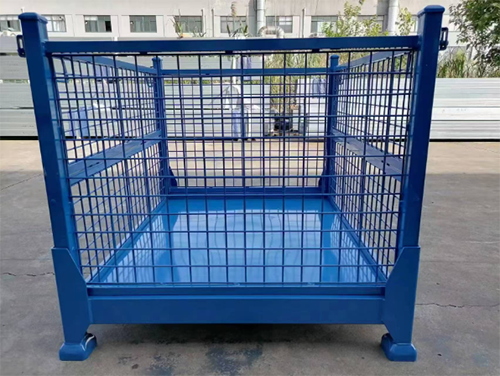
A wire mesh container is a heavy-duty storage and transport unit made from welded steel wire panels, typically mounted on a reinforced steel base. Unlike solid bins or boxes, its open mesh construction allows users to clearly see stored contents while maintaining structural strength.
Most wire mesh containers are designed to be:
- Stackable, allowing vertical storage
- Compatible with forklifts and pallet jacks
- Collapsible, reducing space when empty
- Configurable, with options such as drop gates, casters, dividers, or label holders
These characteristics make wire mesh containers a practical choice for both long-term storage and short-term material flow.
Key Benefits of Wire Mesh Containers
1. Strength and Long-Term Durability
Wire mesh containers are typically manufactured from high-tensile steel wire with reinforced weld points. This construction enables them to support heavy loads without deformation, making them suitable for industrial environments where reliability is critical.
Compared to wooden crates or plastic bins, steel wire containers:
- Resist impact damage
- Perform better under repeated use
- Maintain structural integrity over long service cycles
This durability translates into a lower total cost of ownership over time.
2. Improved Space Utilization
Efficient use of warehouse space is a constant challenge. Wire mesh containers address this in two key ways:
- Vertical stacking: Their stable design allows multiple units to be stacked safely, maximizing cubic storage space.
- Collapsible design: When empty, foldable containers can be collapsed flat, significantly reducing the space required for return transport or off-season storage.
For facilities with fluctuating inventory levels, this flexibility is a major operational advantage.
3. Enhanced Inventory Visibility
The open mesh structure allows warehouse staff to identify contents instantly without opening lids or removing covers.
This improves:
- Picking and sorting speed
- Inventory accuracy
- Cycle counting efficiency
In fast-paced operations, even small time savings at the task level can lead to substantial productivity gains.
4. Operational Flexibility
Wire mesh containers can be adapted to a wide range of workflows. Optional features include:
- Front drop-down gates for easy access
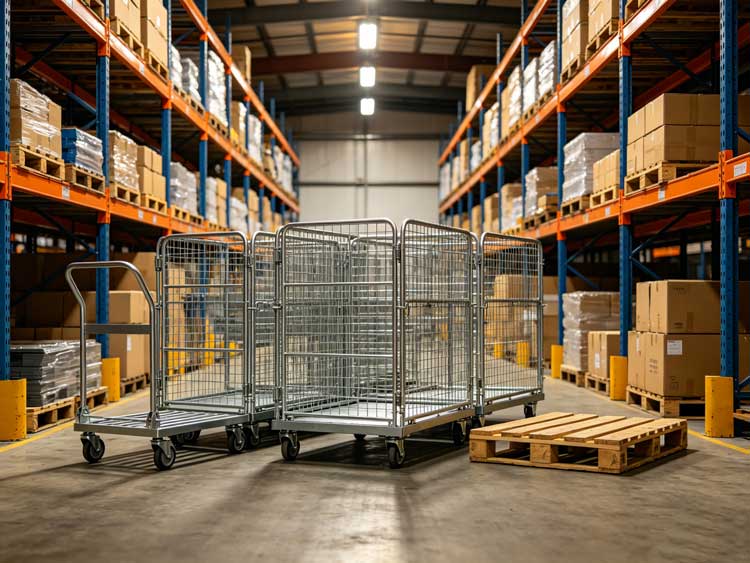
- Casters for manual movement
- Internal dividers for SKU separation
- Label plates for identification and tracking
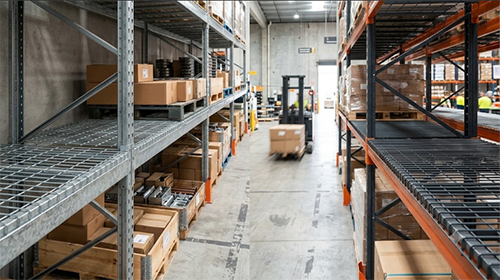
They integrate seamlessly with forklifts, conveyors, and racking systems, making them suitable for both static storage and dynamic material handling.
Common Types of Wire Mesh Containers
Standard Fixed Containers
Designed for heavy loads and long-term storage, these are commonly used in warehouses and manufacturing facilities.
Collapsible Wire Mesh Containers
These fold flat when not in use, ideal for return logistics, seasonal inventory, or space-constrained operations.
Mobile Wire Mesh Containers
Equipped with wheels or casters, these units support internal transport between workstations or production lines.
Customized Containers
For specialized applications, containers can be reinforced, partially enclosed, or sized to specific product dimensions.
Typical Applications Across Industries
Wire mesh containers are widely used because they adapt well to different operational environments:
- Warehousing & Distribution: Bulk storage, order consolidation, returns processing
- Manufacturing: Work-in-process storage, component staging, line-side supply
- Logistics Centers: Sorting, cross-docking, and internal transfers
- Retail & E-commerce: Back-of-house storage, replenishment, and reverse logistics
Their durability and visibility make them particularly effective in environments where goods move frequently.
How to Choose the Right Wire Mesh Container
Load Capacity
Choose a container rated for the maximum expected weight, including safety margins.
Dimensions
Ensure compatibility with pallet sizes, racking systems, and transport equipment.
Stackability & Collapsibility
Determine whether vertical stacking or space-saving collapse is more critical for your operation.
Access & Safety
Drop gates, locking options, or solid panels may be necessary depending on product type.
Accessories & Integration
Consider how labels, dividers, or wheels fit into your workflow.
A well-matched container improves efficiency; a poorly chosen one can create bottlenecks.
Wire Mesh Containers vs Other Storage Options
- Vs. plastic bins: Higher load capacity and better durability for heavy or sharp items.
- Vs. wooden crates: Cleaner, longer-lasting, and easier to inspect.
- Vs. cardboard boxes: Superior protection, reusability, and structural stability.
For industrial and high-volume environments, wire mesh containers consistently outperform disposable or lightweight alternatives.
Conclusion
Wire mesh containers are more than simple storage units—they are a strategic tool for improving warehouse efficiency, visibility, and space utilization. Their strength, flexibility, and long service life make them an essential component of modern material-handling systems.
By selecting the right configuration for your operation, wire mesh containers can reduce handling time, improve inventory control, and support scalable growth.
If your facility is looking to optimize storage and internal logistics, wire mesh containers are a solution worth serious consideration.