




 Time:11/9/2026
 5
The main difference between a Euro pallet and a US pallet is their size. A standard Euro pallet (EPAL 1) measures 1200 × 800 mm, while the most common US pallet measures 48 × 40 inches (1219 × 1016 mm).
These differences affect more than transportation. Pallet dimensions and construction also influence warehouse storage layouts, rack beam lengths, pallet support, and forklift handling. Understanding both formats helps businesses select compatible pallet racking systems and avoid costly storage modifications.

What Is a Euro Pallet?
A Euro pallet typically refers to the EUR/EPAL 1 pallet, which measures 1200 × 800 mm (47.24 × 31.50 inches). It is widely used across Europe for transporting and storing goods.
The standard EPAL 1 wooden pallet has a height of 144 mm and is designed for handling by suitable forklifts and pallet trucks. Its standardized construction supports consistent handling within European logistics networks.
Other European pallet sizes also exist, so the term "Euro pallet" should not be applied to every pallet used in Europe.
What Is a US Pallet?
The most common US pallet is the 48 × 40-inch pallet, often associated with the Grocery Manufacturers Association (GMA) format.
It measures approximately 1219 × 1016 mm and is widely used in North American warehouses, distribution centers, and retail supply chains.
Unlike the standardized EPAL 1 pallet, 48 × 40-inch pallets can vary in construction, deck board arrangement, and load capacity depending on the manufacturer and intended application. Other pallet dimensions are also used in the United States.
Euro Pallet vs US Pallet: Key Differences
The following table compares the two common pallet formats used in international warehousing and logistics.
| Feature | Euro Pallet (EPAL 1) | US Pallet (48 × 40) |
|---|---|---|
| Dimensions | 1200 × 800 mm | 1219 × 1016 mm |
| Size in Inches | 47.24 × 31.50 in | 48 × 40 in |
| Main Market | Europe | North America |
| Footprint | 0.96 m² | Approx. 1.24 m² |
| Construction | Standardized wooden design | Various wooden designs |
| Common Use | European logistics | Retail and distribution |
KEY SIZE DIFFERENCE
A US 48 × 40 pallet has approximately 29% more footprint area than an EPAL 1 Euro pallet.
This is a pallet footprint comparison, not a direct measure of warehouse storage efficiency.
The EPAL 1 pallet follows a defined specification covering dimensions, construction, and quality requirements. In contrast, the common US 48 × 40-inch pallet is widely associated with the GMA format, but its construction and load ratings may vary between manufacturers.
Therefore, pallet dimensions alone should not be used to determine load capacity or racking suitability.
Does Pallet Material Affect Compatibility?
Euro and US pallet dimensions are not limited to wooden pallets. Plastic and steel pallets can also be manufactured in similar sizes.
Wooden pallets are widely used in general logistics because they are economical and relatively easy to repair. Plastic pallets are often selected for reusable handling and applications requiring easier cleaning, while steel pallets are commonly used in demanding industrial environments.
Material selection also affects how a pallet performs on warehouse racks. Some plastic pallets require additional support to control deflection under load. Steel pallets may have different base structures and contact points compared with wooden pallets.
When selecting pallet racking, consider the pallet's dimensions, bottom construction, rated load, and support requirements rather than material alone.
Can Euro Pallets and US Pallets Use the Same Pallet Racking?
Both pallet types can be stored on properly designed pallet racking systems, but they are not automatically interchangeable. The difference in pallet dimensions affects several aspects of rack design.
Beam Length and Pallet Spacing
A rack bay designed for two Euro pallets may not provide enough space for two US pallets in the same orientation. Beam length must account for pallet dimensions and the required handling clearances.
Pallet Support
The pallet's bottom structure determines how it transfers weight to the rack beams. Depending on the pallet design, additional support bars or decking may be required.
Rack Depth and Pallet Orientation
Pallet orientation affects the required rack depth and how the pallet is supported. The intended loading direction must be considered when designing the system.
Forklift Handling
Forklift access, aisle width, and operating clearances should also be checked, especially when switching between pallet formats.
Pallet Overhang and Clearance
Pallets must have suitable support and clearance within the racking system. Incorrect pallet orientation, insufficient beam support, or inadequate handling clearance can create safety risks. When switching between Euro and US pallets, the rack configuration should be checked against the actual pallet dimensions, bottom structure, and loaded weight.
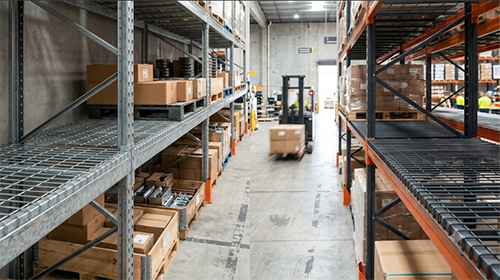
For warehouses handling both European and American pallets, a properly configured selective pallet racking system can accommodate different pallet sizes when beam dimensions, support arrangements, and load ratings are suitable.
Which Pallet Size Should You Choose for Your Warehouse?
The choice between Euro and US pallets usually depends on your supply chain and existing warehouse equipment.
If most goods are transported within Europe, the 1200 × 800 mm Euro pallet may be the more practical option. For businesses operating primarily in North America, the 48 × 40-inch pallet is commonly preferred.
International warehouses may need to handle both formats. Before selecting new pallets or installing pallet racking, confirm the dimensions of incoming goods, pallet load capacities, handling equipment, and available storage space.
Designing the racking system around the actual pallets used in daily operations can help avoid compatibility problems and unnecessary modifications later.
Conclusion
Euro pallets and US pallets differ mainly in dimensions, but their construction and support requirements also affect warehouse storage design.
Whether your warehouse uses 1200 × 800 mm Euro pallets, 48 × 40-inch US pallets, or both, the racking system should be designed around the actual pallet dimensions, loads, and handling requirements.
For warehouses handling multiple pallet formats, a properly configured selective pallet racking system can provide the flexibility needed for efficient storage.