-
 E-mail:
aceally4@aceallygroup.com
E-mail:
aceally4@aceallygroup.com
-
 Wechat: +8618350222213


-

-
Aceally Logistics StorageSaving your time, Creating fortune for you

-
 Time:7/17/2026
 -
 Time:7/15/2026
 -
-
-
 Time:5/22/2026

- CONTACT US
- Wechat: +8618350222213
- aceally4@aceallygroup.com
Wire Mesh Decking Guide 2026 | Types, Sizes, Benefits & Buying Tips
 Time:6/16/2026
 158
158Wire Mesh Decking: The Complete Guide for Safer & More Efficient Warehouse Storage
Learn everything about wire mesh decking, including its types, applications, load capacities, installation methods, fire safety advantages, and expert buying tips to optimize pallet racking systems.
Why Wire Mesh Decking Matters in Modern Warehouses
As warehouses continue to pursue higher storage density, improved safety, and better operational efficiency, selecting the right pallet racking accessories has become increasingly important. Among these accessories, wire mesh decking has emerged as one of the most widely adopted solutions for supporting palletized goods and loose inventory across distribution centers, manufacturing facilities, retail warehouses, and e-commerce fulfillment operations.
Compared with traditional wood panels or solid steel shelves, wire mesh decking provides enhanced visibility, improved airflow, superior fire sprinkler penetration, and excellent durability while requiring minimal maintenance. It can be installed quickly on selective pallet racks and many other racking systems, making it a cost-effective upgrade for warehouses seeking safer and more reliable storage.
Whether you are planning a new warehouse, replacing damaged rack components, or sourcing products from a reliable wire mesh decking supplier, understanding deck types, dimensions, materials, and load ratings is essential for making informed decisions.
This comprehensive guide explains everything you need to know about industrial wire mesh decking, including standard sizes, waterfall and flared designs, galvanized and powder-coated finishes, engineering considerations, installation practices, and purchasing recommendations for global buyers.
Key Takeaways
- Wire mesh decking increases warehouse safety and rack stability.
- It improves fire sprinkler effectiveness through better water penetration.
- Multiple configurations are available, including waterfall, flared, and U-channel wire decks.
- Load capacity depends on wire gauge, support channels, dimensions, and beam compatibility.
- Galvanized and powder-coated finishes serve different environmental requirements.
- Choosing the correct pallet rack wire decking helps reduce maintenance costs and extend rack life.
- Custom wire mesh decking can be manufactured to meet unique warehouse specifications and OEM needs.
What Is Wire Mesh Decking?
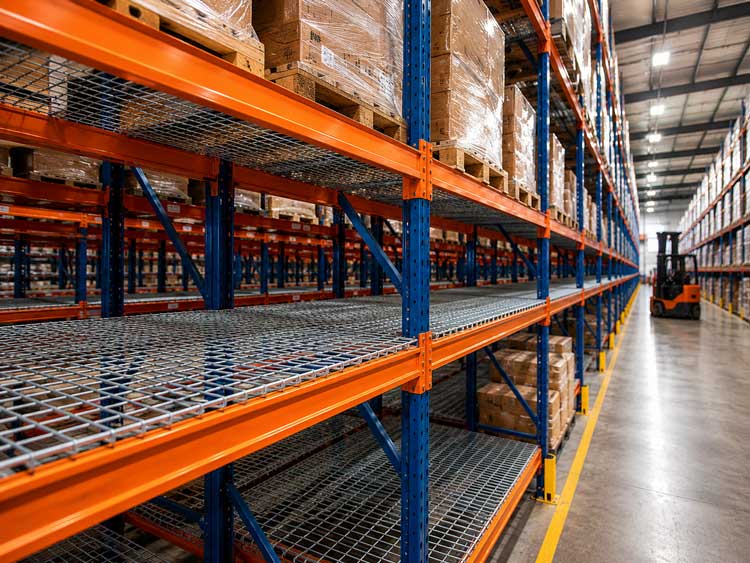
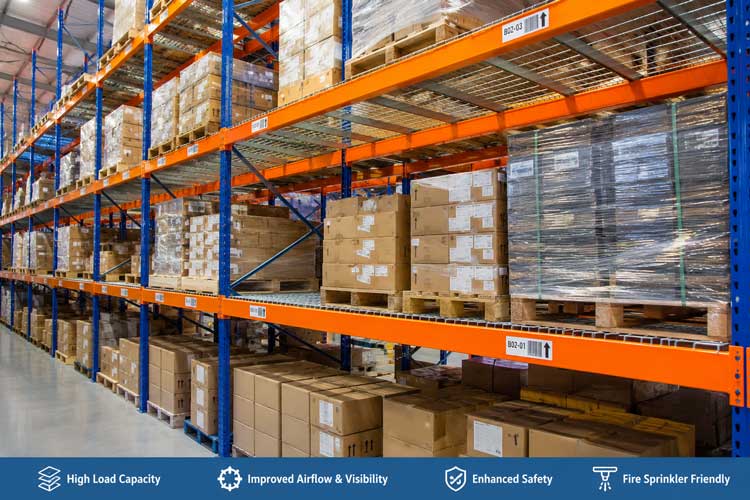
Wire mesh decking, also known as wire deck, wire rack decking, or pallet rack wire decking, is a welded steel panel designed to sit securely on pallet rack beams. It creates a stable load-supporting surface for pallets, cartons, bins, and irregularly shaped inventory while maintaining excellent visibility and airflow throughout the storage system.
Unlike plywood or solid steel panels, a wire mesh deck features an open-grid construction that allows light, air, and fire sprinkler water to pass through more effectively. This design can improve warehouse safety, facilitate inventory inspections, and reduce dust accumulation in storage environments.
Today, wire mesh decking is widely used with selective pallet racking and can also be integrated into many other industrial storage systems. It is a common choice for logistics centers, manufacturing plants, third-party logistics providers (3PLs), retail distribution hubs, food warehouses, and e-commerce fulfillment facilities.
How Does Wire Mesh Decking Work?
A wire mesh deck distributes the weight of stored goods across welded steel wires and reinforced support channels beneath the deck. These support channels transfer the load onto the pallet rack beams, helping maintain structural stability under properly rated working conditions.
Because the deck simply rests on compatible beams without requiring complex fasteners in most applications, installation is quick and replacement is straightforward. This modular design also allows warehouses to adapt storage layouts as inventory profiles change.
- Place the wire deck onto compatible pallet rack beams.
- Ensure waterfall edges or flared ends seat correctly on the beams.
- Support channels beneath the deck distribute the load.
- Pallets or cartons are stored on the deck within the rated capacity.
- The open mesh design maintains visibility and allows sprinkler penetration.
Main Components of a Wire Mesh Deck
| Component | Purpose |
|---|---|
| Welded Wire Mesh Surface | Provides the primary load-supporting platform. |
| Support Channels | Increase rigidity and transfer loads to rack beams. |
| Waterfall or Flared Edge | Improves positioning and stability on the beam. |
| Steel Wire | Forms the open-grid structure for airflow and visibility. |
| Protective Finish | Enhances corrosion resistance through powder coating or galvanizing. |
Top Benefits of Wire Mesh Decking
1. Enhanced Warehouse Safety
Properly specified wire mesh decking helps reduce the risk of unstable loads and supports storage of pallets, cartons, and smaller items that might otherwise fall through open rack beams.
2. Improved Fire Protection
The open-grid structure allows water from overhead sprinklers to pass through more effectively than many solid shelf surfaces, making wire mesh decking a preferred solution in facilities where fire protection performance is an important design consideration.
3. Better Air Circulation
Increased airflow helps maintain cleaner storage conditions and can be particularly beneficial in temperature- controlled environments or facilities requiring improved ventilation.
4. Excellent Inventory Visibility
Warehouse personnel can often see labels and products through the mesh, making inspections and inventory management more efficient.
5. High Strength-to-Weight Ratio
Reinforced steel construction provides substantial load-bearing capability while remaining relatively light, simplifying handling and installation.
6. Fast Installation
Most wire mesh decking panels can be placed directly onto compatible pallet rack beams without specialized tools, reducing installation time during warehouse setup or expansion.
7. Durable and Low Maintenance
Powder-coated and galvanized wire mesh decks resist wear and corrosion under appropriate operating conditions, contributing to a long service life with minimal maintenance requirements.
8. Supports Diverse Inventory
In addition to palletized goods, wire decks can support cartons, plastic containers, totes, and other items that may not rest securely on beam-only rack configurations.
9. Suitable for Custom Manufacturing
Manufacturers can produce custom wire mesh decking in a wide range of widths, depths, wire diameters, support channel configurations, and finishes to match project-specific requirements.
10. Cost-Effective Over the Product Lifecycle
Although specifications and pricing vary, durable steel wire decking can reduce replacement frequency and maintenance costs compared with less robust alternatives, offering long-term value for many warehouse operations.
Expert Tip
Always verify beam compatibility, deck dimensions, and rated load capacity before installation. Selecting the correct wire mesh decking specification for your pallet racking system helps promote safe operation and reliable long-term performance.
Types of Wire Mesh Decking
Wire mesh decking is not a one-size-fits-all product. Different pallet rack systems, load requirements, and warehouse environments require specific structural designs. Understanding the main types of wire mesh decking for pallet racks is essential for selecting the right solution for safety, efficiency, and long-term performance.
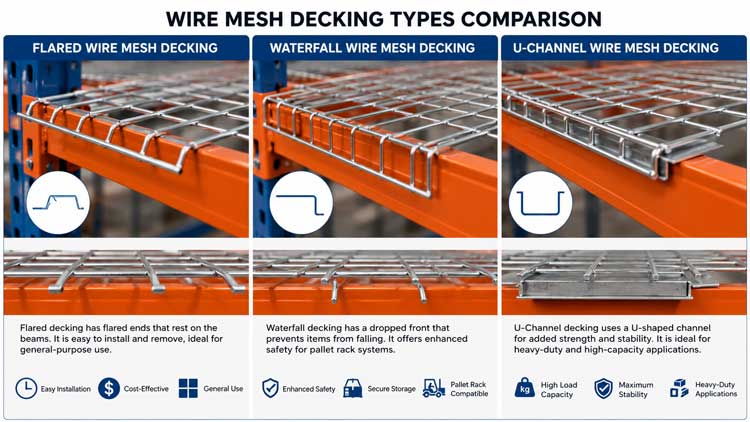
1. Flared Wire Mesh Decking
Flared wire mesh decking is one of the most commonly used configurations in selective pallet racking systems. The flared edges rest on the inside of the beam, allowing quick installation without additional fasteners in most applications.
This type is widely used in general warehouse storage, distribution centers, and retail logistics operations due to its cost-effectiveness and compatibility with standard rack beam profiles.
2. Waterfall Wire Mesh Decking
Waterfall wire mesh decking features a downward “waterfall” edge that wraps over the beam, increasing stability and preventing movement during loading and unloading operations.
This design is commonly used in high-traffic warehouses where safety and structural integrity are critical, such as third-party logistics (3PL) hubs and high-volume distribution centers.
3. U-Channel Wire Mesh Decking
U-channel wire mesh decking uses reinforced steel channels underneath the mesh surface to significantly improve load-bearing capacity. The U-shaped support beams distribute weight evenly across the rack structure.
This type is often selected for heavy-duty industrial applications requiring higher load ratings per shelf level, especially in manufacturing and bulk storage environments.
4. Inside Waterfall Wire Decking
Inside waterfall wire decking is designed to sit within the beam frame rather than over it, providing a flush and clean installation appearance.
This type is typically used in customized pallet racking systems where precise dimensional fit and optimized storage aesthetics are required.
5. Reverse Flared Wire Mesh Decking
Reverse flared decking is a specialized design used for non-standard beam configurations or engineered rack systems. It is often manufactured as a custom solution for unique warehouse layouts.
Materials and Surface Finishes
The performance and durability of industrial wire mesh decking largely depend on the steel grade, wire diameter, welding quality, and surface treatment. Selecting the right finish is critical for different warehouse environments.
Galvanized Wire Mesh Decking
Galvanized wire mesh decking is treated with a zinc coating that provides excellent corrosion resistance. It is widely used in cold storage facilities, humid environments, and outdoor or semi-outdoor warehouses.
This finish is one of the most popular options for global buyers seeking long-term durability and low maintenance requirements.
Powder Coated Wire Mesh Decking
Powder coated wire decking provides a smooth protective finish that enhances corrosion resistance while improving visual appearance.
It is commonly used in indoor warehouses, retail distribution centers, and facilities where aesthetics and color consistency are important.
Heavy Duty Steel Wire Mesh Decking
Heavy duty wire mesh decking uses thicker steel wire and reinforced support channels to achieve higher load ratings. It is designed for demanding industrial storage environments where pallets and goods are heavier than standard applications.
Standard Sizes of Wire Mesh Decking
Standard dimensions of wire mesh decking panels vary depending on pallet rack beam spacing, warehouse layout, and load requirements. However, several commonly used sizes are widely adopted in global warehouse systems.
| Width | Depth | Typical Load Capacity |
|---|---|---|
| 36 inches | 42 inches | Up to 2,500 lbs |
| 42 inches | 46 inches | Up to 3,000 lbs |
| 48 inches | 46 inches | Up to 3,500 lbs |
| 48 inches | 48 inches | Up to 4,000 lbs |
Load Capacity and Engineering Considerations
The load capacity of pallet rack wire mesh decking is determined by multiple engineering factors rather than a single specification. These include wire gauge, support channel design, beam spacing, and overall deck dimensions.
- Uniform Distributed Load (UDL): Weight spread evenly across the deck surface.
- Point Load: Concentrated weight at specific contact points.
- Beam Span: Distance between pallet rack beams directly affects strength.
- Wire Gauge: Thicker wire increases structural strength.
- Support Channels: Reinforcement design significantly improves load capacity.
In professional warehouse design, engineers always evaluate rack system compatibility before selecting wire decking to ensure safe operating conditions and compliance with warehouse safety standards.
Engineering Insight
Even if two wire mesh decks have the same dimensions, their load capacity may differ significantly due to differences in wire thickness, weld quality, and support channel configuration. Always request technical specifications from your supplier.
Applications of Wire Mesh Decking in Modern Warehouses
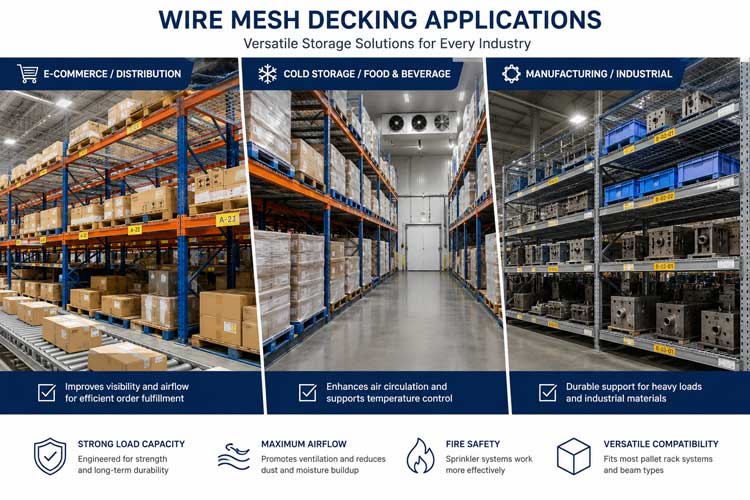
Wire mesh decking for pallet racks is widely used across multiple industries due to its versatility, safety advantages, and compatibility with standard racking systems. From high-volume logistics centers to temperature-controlled warehouses, it provides a reliable load-supporting surface for different types of goods.
1. E-commerce Fulfillment Centers
In fast-moving e-commerce warehouses, wire mesh rack decking is used to support cartons, bins, and mixed SKU inventory. The open design improves visibility and allows workers to quickly identify products during picking and packing operations.
2. Distribution Centers & 3PL Warehouses
Third-party logistics providers (3PLs) rely on industrial wire mesh decking to handle high-throughput storage systems. The structure improves safety in busy aisles and supports a wide range of pallet sizes.
3. Cold Storage Warehouses
Galvanized wire mesh decking is particularly suitable for cold storage environments due to its corrosion resistance and ability to withstand low-temperature conditions without deformation.
4. Manufacturing Facilities
Manufacturing plants often use heavy duty wire mesh decking to store raw materials, components, and semi-finished goods. Its load-bearing capacity supports industrial-scale storage requirements.
5. Retail & Wholesale Distribution
Retail distribution centers use wire decking to organize mixed product flows. The open structure enhances inventory visibility and reduces product damage caused by unstable stacking.
How to Install Wire Mesh Decking
One of the major advantages of pallet rack wire mesh decking is its simple installation process. Most configurations are designed for direct placement onto compatible pallet rack beams without requiring specialized tools or complex fastening systems.
- Inspect pallet rack beams to ensure structural integrity and correct spacing.
- Verify that wire mesh deck dimensions match beam clear span requirements.
- Carefully place the decking panel onto the rack beams.
- Ensure waterfall or flared edges are properly seated on the beams.
- Check alignment and stability before loading any goods.
- Perform a load test for high-capacity or heavy-duty applications.
Proper installation is essential to ensure safe operation and to fully achieve the designed load capacity of the wire mesh decking system.
Safety Standards and Fire Protection Benefits
Safety is one of the primary reasons warehouses choose wire mesh decking systems over traditional solid shelving materials. The open-grid structure provides several operational and regulatory advantages.
Improved Fire Sprinkler Performance
The open design of wire mesh decking allows water from overhead fire sprinklers to pass through unobstructed, improving fire suppression efficiency and helping warehouses comply with fire safety requirements in many regions.
Reduced Falling Object Risk
Wire decking helps prevent smaller cartons, tools, or irregular items from falling through rack beams, improving workplace safety for warehouse personnel operating beneath storage levels.
Compliance with Warehouse Safety Standards
Many warehouse operators adopt industrial wire mesh decking as part of compliance with internationally recognized safety guidelines such as RMI (Rack Manufacturers Institute) and FEM standards.
How to Choose the Right Wire Mesh Decking
Selecting the correct wire mesh decking for pallet racks requires careful evaluation of both technical specifications and operational requirements. The wrong selection may result in reduced load capacity, safety risks, or inefficient warehouse utilization.
1. Rack Beam Compatibility
Ensure the decking type (flared, waterfall, U-channel) matches the beam profile of your pallet racking system.
2. Load Capacity Requirements
Evaluate both uniformly distributed load (UDL) and point load requirements based on stored goods weight.
3. Warehouse Environment
Choose galvanized wire mesh decking for humid or cold storage environments, and powder-coated options for standard indoor warehouses.
4. Inventory Type
Cartons, pallets, and irregular goods may require different mesh spacing and reinforcement channel designs.
5. Budget and Lifecycle Cost
While initial cost matters, long-term durability and reduced maintenance often make high-quality wire mesh decking a more cost-effective investment.
Procurement Insight
For B2B buyers, requesting technical drawings, load test reports, and material specifications from suppliers is essential before placing bulk orders for wire mesh decking systems.
Wire Mesh Decking vs Other Rack Decking Options
When selecting pallet racking accessories, warehouses often compare wire mesh decking with other common decking solutions such as wood panels, solid steel shelves, and particle board. Each option has distinct performance characteristics in terms of safety, cost, durability, and fire protection.
| Feature | Wire Mesh Decking | Wood Panels | Solid Steel Decking |
|---|---|---|---|
| Fire Safety | High (open structure) | Low | High |
| Airflow | Excellent | Poor | Poor |
| Visibility | High | Low | Low |
| Durability | High | Medium | Very High |
| Maintenance | Low | High | Low |
Frequently Asked Questions (FAQ)
1. What is wire mesh decking used for?
It is used to support pallets, cartons, and loose inventory on pallet rack systems while improving safety, airflow, and fire sprinkler effectiveness in warehouses.
2. How much weight can wire mesh decking hold?
Load capacity depends on wire gauge, support channels, and beam span. Typical capacities range from 2,000 lbs to over 4,000 lbs per panel in standard warehouse applications.
3. Is wire mesh decking required for pallet racking?
It is not always mandatory, but many warehouses use it for safety compliance, especially where fire codes or insurance requirements recommend open-deck systems.
4. What is the difference between flared and waterfall wire decking?
Flared decking sits inside the beam, while waterfall decking wraps over the beam, providing higher stability and improved safety in high-traffic warehouses.
5. Can wire mesh decking be customized?
Yes. Manufacturers offer custom sizes, wire thickness, finishes, load ratings, and beam compatibility options for OEM and project-based warehouse solutions.
6. Is galvanized wire mesh decking better?
Galvanized decking provides better corrosion resistance and is preferred for cold storage, humid environments, and long-term industrial use.
7. How long does wire mesh decking last?
With proper use and correct load distribution, wire mesh decking can last many years, often exceeding the lifecycle of alternative shelving materials.
8. Is wire mesh decking suitable for cold storage?
Yes. Galvanized wire mesh decking is commonly used in cold storage facilities due to its resistance to moisture and temperature variation.
Conclusion
Wire mesh decking is one of the most efficient and widely adopted pallet rack accessories in modern warehouse storage systems. Its combination of safety, durability, fire compliance benefits, and operational flexibility makes it a preferred choice across industries such as logistics, manufacturing, retail distribution, and cold storage.
Selecting the right type—whether flared, waterfall, or heavy-duty U-channel—ensures optimal performance and long-term value. By understanding load capacity, material options, and installation requirements, warehouse operators can significantly improve both safety and efficiency.
Looking for High-Quality Wire Mesh Decking?
We supply industrial-grade wire mesh decking with custom sizes, OEM options, and global shipping support. Contact us to get a quote for your pallet racking system project.
Request a Quote Today → Improve Warehouse Safety & Efficiency
Related Warehouse Storage Solutions
- Selective Pallet Racking System Guide
- Drive-In Racking vs Selective Racking
- Radio Shuttle Racking System Overview
- Wire Mesh Container Applications
- Steel Pallet vs Plastic Pallet Comparison
This guide is designed to help warehouse operators, distributors, and procurement teams understand wire mesh decking systems and select the most suitable solution for their storage requirements.